
An Aluminium Casting Mold is the shaped tool that gives molten aluminium its final form. It contains a carefully designed cavity, supported by gates, runners, risers, and vents. These features control how metal enters, fills, and solidifies. The mold may be made from steel, sand, ceramic, or another heat-resistant material. Each choice changes production speed, surface quality, cost, and acceptable design limits.
The process begins with mold preparation. A permanent mold is usually preheated and coated with a release agent. Molten aluminium then flows through the gating system into the cavity. Air must escape quickly. Otherwise, trapped gas can create porosity, weak areas, or visible surface defects. After cooling, the casting is removed, trimmed, inspected, and sometimes heat-treated. Small details matter. A sharp corner can restrict flow and concentrate stress. A poorly positioned riser can leave shrinkage inside the part.
Casting authority John Campbell, widely recognized for his work on foundry technology, states, “The mould is the heart of the casting process.” That observation remains practical on the workshop floor. Mold design affects nearly every later result, from dimensional accuracy to fatigue performance. Still, the phrase is not a complete explanation. Alloy chemistry, pouring temperature, filling speed, and operator experience also influence quality. A well-designed mold cannot rescue careless process control.
This guide explains what an Aluminium Casting Mold is, how it works, and why its design requires both engineering judgment and production experience. Expect useful principles, but not effortless answers. Real castings often reveal flaws that drawings do not show.
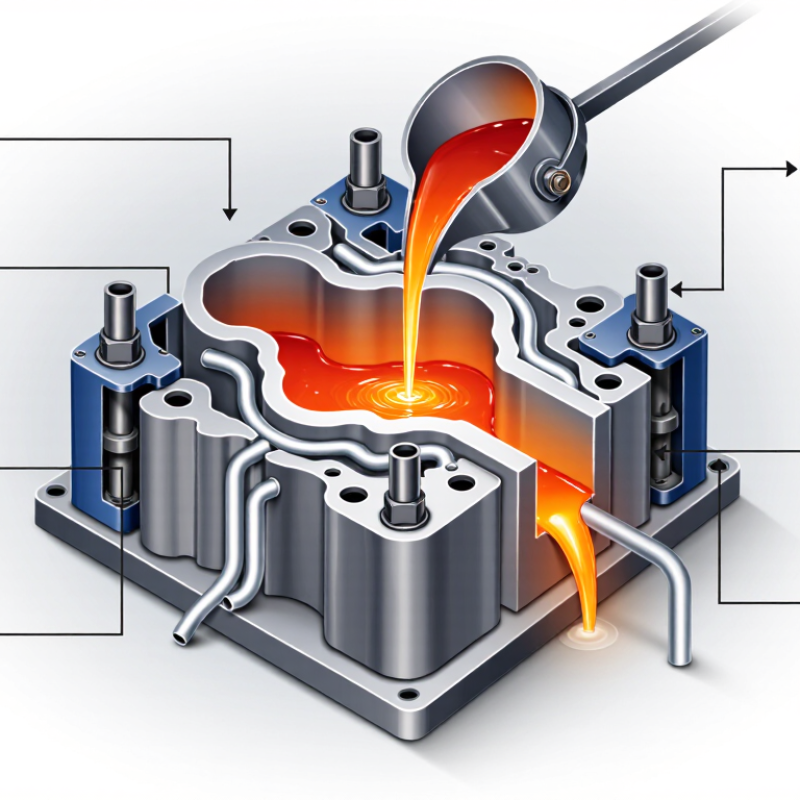
An aluminium casting mold is a shaped cavity that gives molten aluminium its final form. It is usually made from steel, iron, sand, or ceramic materials. The mold is not normally aluminium itself. Its job is to control filling, cooling, and solidification.
During casting, technicians heat aluminium until it becomes liquid. They pour it into the prepared cavity through a gate system. Vents allow trapped air to escape. Risers feed extra metal during shrinkage. A mold with poor venting may create pores, incomplete edges, or weak surfaces. The U.S. Geological Survey reported about 70 million tonnes of global primary aluminium production in 2023. This scale makes mold accuracy increasingly important. Even a small dimensional error can multiply across thousands of castings.
The mold’s design depends on the part, production volume, and required surface finish. Sand molds suit complex shapes and lower volumes. Permanent metal molds offer repeatable dimensions. High-pressure molds support fast production, but they require careful temperature control. The International Aluminium Institute notes that recycling aluminium can save about 95% of the energy used for primary production. This encourages more recycled feedstock, although its chemistry may vary. That assumption can fail without proper inspection.
An aluminium casting mold shapes molten metal as it cools and solidifies. Its construction depends on production volume, alloy choice, and required surface quality. Steel is common for permanent molds because it tolerates repeated heating and cooling. Aluminum molds are lighter and machine easily, but they usually suit shorter production runs. Sand molds remain practical for complex shapes and large components.
Each mold needs more than a hollow cavity. Designers add gates to guide metal, runners to distribute flow, and vents to release trapped air. A carefully placed riser can feed shrinkage during solidification. Ceramic or sand cores create internal passages, such as cooling channels or hollow chambers. Refractory coatings may reduce sticking and improve the casting surface.
The design must account for thermal expansion. Even a small error can alter dimensions after cooling. Draft angles help the part leave the mold without scraping its walls. Rounded corners reduce turbulence and stress concentration. Cooling lines can shorten cycle times, though uneven cooling may cause warping. It is easy to overdesign a mold. In practice, a simpler cavity often performs better and costs less to maintain. No mold is perfect; inspection, trial castings, and measured adjustments remain necessary. Experienced technicians check flash, porosity, surface marks, and dimensional drift before approving regular production.
An aluminium casting mold is a shaped cavity that receives molten aluminium and controls its final form. It may be made from steel, iron, sand, or ceramic materials. The preparation method depends on production volume, part size, and required surface quality. A permanent metal mold suits repeated production, while a sand mold offers greater flexibility for complex shapes.
Mold preparation begins with a clean pattern or a carefully designed mold cavity. Engineers allow for aluminium shrinkage during cooling, usually around one percent, although the exact value depends on the alloy and part design. The cavity is checked for sharp corners, uneven walls, and trapped air. Small vents help gases escape. Without proper venting, bubbles or rough patches may appear on the casting.
The mold is then cleaned, dried, and coated when necessary. A thin release coating can improve surface finish and reduce sticking. Before pouring, operators inspect alignment, clamping, temperature, and moisture levels. Even a small amount of moisture can create dangerous steam and damage the casting. In practical work, preparation is rarely perfect. A vent may be too narrow, or a surface may cool unevenly. Careful inspection after each casting helps reveal these weaknesses and improve the next mold.
What Is an Aluminium Casting Mold and How Does It Work?
An aluminium casting mold is a shaped cavity that gives molten metal its final form. It may use sand, steel, or another heat-resistant material. Good castings begin before the furnace is lit. The mold must match the component’s dimensions, wall thickness, and cooling needs.
How Does the Aluminium Casting Process Work Step by Step?
A pattern first creates the mold cavity. Technicians then add gates, runners, and vents for controlled metal flow. The selected aluminium alloy is melted in a clean, monitored furnace. Its pouring temperature depends on the alloy and mold design. The liquid metal enters through the sprue and fills the cavity. It must flow steadily, without trapping excessive air. The mold then cools while the metal solidifies and shrinks. After removal, workers cut away gates and risers. They inspect surfaces, dimensions, and possible internal defects. This stage often exposes small issues that were invisible during pouring.
Tips: Keep moisture away from molten aluminium. Even a damp tool can create dangerous splashing. Preheat metal tools and check vents before pouring. Use proper protective equipment and follow trained foundry procedures. A slightly rough surface may result from poor mold packing, not bad metal. Review each casting honestly. Small changes in temperature, pressure, or cooling time can improve the next result.
| Process Stage | Main Equipment or Mold Element | What Happens | Typical Parameters | Quality Consideration |
|---|---|---|---|---|
| 1. Part and Mold Design | Pattern, CAD model, mold halves, cores | The component geometry, parting line, gates, risers, vents, draft angles, and shrinkage allowance are defined. | Typical draft angle: about 1–3° for many cast surfaces; greater draft may be needed for deep features. | Correct mold alignment and sufficient draft help prevent sticking, distortion, and surface damage. |
| 2. Mold Preparation | Permanent steel mold or sand mold | The mold is cleaned, assembled, coated when required, and preheated for the selected casting method. | Permanent molds are commonly preheated to approximately 150–300°C, depending on design and alloy. | Preheating reduces thermal shock and can improve metal flow and filling consistency. |
| 3. Aluminium Charge Preparation | Furnace, crucible, charge materials, flux or degassing equipment | Aluminium ingot, return scrap, or approved recycled feedstock is sorted, dried, and prepared for melting. | Charge materials should be free from moisture, oil, and harmful contamination. | Moisture can cause dangerous steam expansion and contamination can increase inclusions or gas defects. |
| 4. Melting | Gas, electric, or induction furnace | The aluminium charge is heated until it becomes fully liquid and suitable for transfer. | Aluminium alloys melt over an approximate range of 570–660°C; exact values depend on alloy composition. | Excessive superheat can increase oxidation, hydrogen absorption, and mold erosion. |
| 5. Melt Treatment | Skimming tools, rotary degassing unit, filters | Oxide films and dross are removed, while dissolved hydrogen may be reduced before pouring. | Filtration and degassing conditions are selected according to alloy, melt volume, and product requirements. | Clean metal helps reduce porosity, inclusions, leakage, and reduced mechanical strength. |
| 6. Mold Filling | Sprue, runner, gates, vents, and mold cavity | Liquid aluminium flows through the gating system and fills the cavity before solidification is complete. | Pouring temperature is commonly about 30–100°C above the alloy liquidus, depending on process and section thickness. | A controlled, non-turbulent flow reduces oxide entrainment and incomplete filling. |
| 7. Solidification | Mold walls, chills, risers, and cooling system | The aluminium loses heat and changes from liquid to solid, while the riser supplies metal during shrinkage. | Solidification time varies from seconds to several minutes, depending on wall thickness, mold material, and casting size. | Directional solidification helps move shrinkage defects toward the riser rather than the finished part. |
| 8. Mold Opening and Part Removal | Ejector pins, clamps, lifting tools, or knockout equipment | After adequate cooling, the mold is opened and the solid casting is removed. | The casting must be sufficiently solid to avoid bending, tearing, or deformation during ejection. | Proper draft, ejection force, and cooling balance protect both the casting and the mold. |
| 9. Trimming and Cleaning | Saw, press, grinder, shot-blasting or deburring equipment | Gates, runners, risers, flash, and unwanted surface material are removed. | Material removal is controlled to preserve critical dimensions and functional surfaces. | Aggressive grinding or blasting may create dimensional variation or surface damage. |
| 10. Inspection and Finishing | Calipers, gauges, visual inspection, radiography, machining tools | The casting is checked for dimensions, surface condition, internal defects, and required mechanical properties. | Possible operations include heat treatment, machining, anodizing, coating, or pressure testing. | Inspection methods should match the part’s safety, pressure, dimensional, and performance requirements. |
An aluminium casting mold shapes molten aluminium under controlled pressure and cooling. Its quality depends on more than steel hardness. Mold design, machining accuracy, heat treatment, and daily handling all matter.
Mold steel must resist thermal fatigue, erosion, and repeated impact. Poor material selection can create heat checks around gates and sharp corners. These fine cracks often look harmless at first. They rarely remain harmless. Smooth transitions reduce stress concentration and improve metal flow. Correct venting also matters. Trapped air can cause porosity, burns, and incomplete filling. Even a small blocked vent may damage surface quality.
Temperature control strongly affects service life. A mold preheated near the recommended range reduces thermal shock during production. Excessive temperature, however, can soften surfaces and increase soldering. Release lubricant should form a thin, even film. Too much lubricant may leave deposits inside vents and cooling channels. In practical shop work, cooling water quality is often underestimated. Hard deposits can narrow channels and create hot spots. Operators should inspect temperatures, flash, surface cracks, and ejection force during each shift. Small changes often reveal bigger problems.
Maintenance records improve judgment, but records are not perfect. A mold may pass visual inspection while hidden fatigue continues beneath the surface. Scheduled polishing, vent cleaning, alignment checks, and dimensional measurements remain essential. Storage conditions also influence reliability. Dry, protected storage prevents corrosion between production runs. Careful operation extends service life, yet no mold lasts forever. Realistic replacement planning is part of responsible quality control.
Thermal conductivity affects how quickly a mold removes heat from molten aluminium. Higher conductivity can shorten cycle time and improve cooling efficiency, while uneven heat removal may increase thermal stress and cracking.
Mold quality and service life also depend on thermal cycling, mold preheating, cooling-channel layout, surface treatment, lubrication, venting, alloy temperature, erosion resistance, and regular maintenance. Values shown are representative room-temperature ranges for commonly used mold materials; the exact value varies by grade, heat treatment, and temperature.