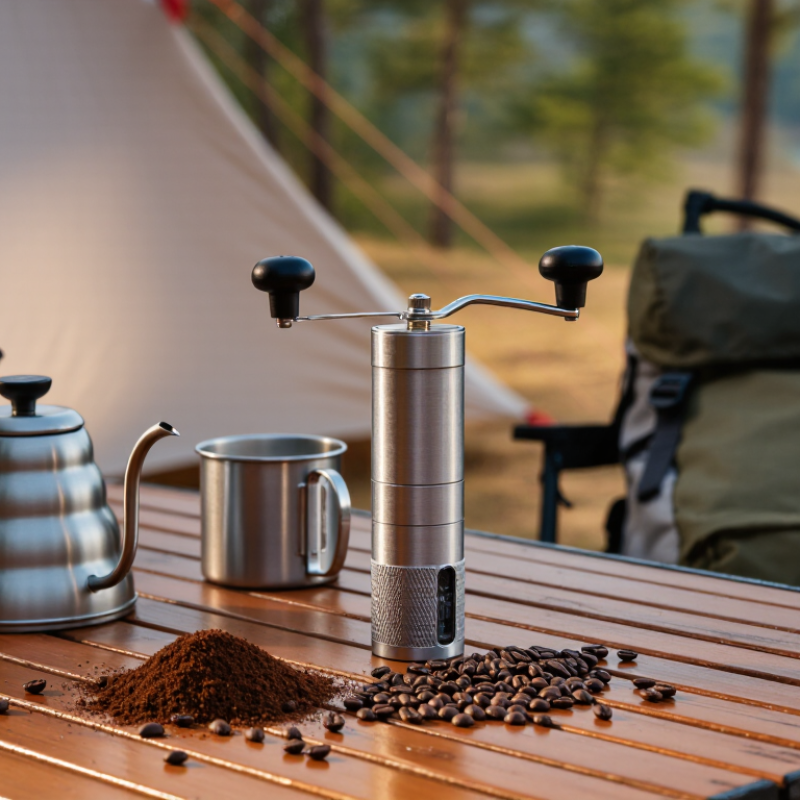
| 1 | Choose the grinder type | Manual grinder: compact and independent of electricity.
Battery-powered grinder: faster and easier for repeated brewing.
Blade grinder: inexpensive but less uniform. | Manual burr grinders commonly weigh about 400–800 g and are suitable for pour-over, AeroPress-style brewing, and French press. Battery-powered models may reduce hand effort but add charging requirements and usually weigh more. | Select a manual burr grinder for remote camping or backpacking. Consider battery power only when convenience is more important than minimum weight. |
| 2 | Compare burr materials | Ceramic burrs: corrosion-resistant and usually lower cost.
Stainless-steel burrs: durable, sharp, and generally faster.
Hardened steel burrs: designed for higher durability and heavier use. | Ceramic burrs do not rust but can chip if dropped or exposed to hard debris. Steel burrs tolerate impacts better and commonly provide faster grinding, but they can develop surface corrosion if stored wet. | For damp environments or rough handling, prioritize a protected steel burr assembly. For occasional dry-weather camping, ceramic can be adequate. |
| 3 | Prioritize grind consistency | Look for a stable center shaft, rigid burr support, and an adjustment system with clear steps or repeatable settings. | A consistent grind contains fewer extreme fines and boulders. This helps reduce harsh extraction from fines and weak extraction from oversized particles, especially in pour-over and immersion brewing. | Check independent testing or user measurements when available. A grinder that produces a visibly mixed particle size may require more brewing adjustments. |
| 4 | Match the adjustment range to your brew method | Fine settings: espresso-style brewing and some moka pots.
Medium settings: pour-over and AeroPress-style brewing.
Coarse settings: French press and cold-brew preparation. | Many compact manual grinders offer approximately 20–40 adjustment steps, while some use stepless adjustment. More settings provide finer control but can make the correct setting slower to find. | Confirm that the grinder can produce both the fine and coarse range required by your camping brewer. Avoid choosing solely by the number of settings. |
| 5 | Balance capacity and packability | Compact grinders often hold 20–30 g of beans per load. Larger travel models may hold about 30–40 g but occupy more pack space. | A 20 g dose is suitable for one strong cup, while 30–40 g can support multiple cups depending on the coffee-to-water ratio. A smaller body is easier to pack but may require multiple grinding cycles. | Compare the bean capacity with your normal serving size. Also measure the grinder, handle, and removable parts when packed together. |
| 6 | Evaluate effort, speed, and ergonomics | Handle length, bearing quality, burr diameter, grip texture, and crank resistance all affect grinding effort. | Grinding 20–30 g of coffee by hand often takes roughly 1–3 minutes, depending on burr size, bean density, roast level, and grind setting. Larger burrs and a longer handle can reduce effort but increase overall size. | Choose a secure grip and a handle that can be stored safely. If several people will drink coffee, prioritize reduced effort over the lightest possible weight. |
| 7 | Check durability and cleaning needs | Favor a rigid body, protected adjustment mechanism, replaceable wear parts, and a design that can be disassembled without tools. | Coffee oils and fine particles can affect adjustment movement and flavor over time. Brushing out loose grounds after each trip and performing a deeper dry cleaning periodically helps maintain operation. Water should not be used on parts that are not designed to be washed. | Confirm whether the burrs, bearings, catch cup, and adjustment ring are removable. Pack the grinder dry and protect the burrs from sand, grit, and impact. |