What Are the Top Oatmeal Chocolate Moulding Machines?

Choosing among the top oatmeal chocolate moulding machines requires more than comparing output figures. The right equipment must handle thick oatmeal mixtures, chocolate viscosity, and consistent mould release. Production managers should examine heating stability, depositing accuracy, cooling performance, and cleaning access. Small differences can affect texture, weight, and appearance across thousands of pieces.

Practical experience matters. A machine may perform smoothly during a short demonstration, yet struggle during a full production shift. Operators should test real oatmeal recipes, including ingredients with nuts, dried fruit, or higher fiber content. Check whether the system supports rapid mould changes and precise temperature control. Food-contact surfaces should be easy to inspect and maintain. Applicable safety and hygiene requirements must also be verified with the manufacturer.

Machines can look perfect on brochures. They are not always perfect in production. Some models may offer impressive speed but require more skilled maintenance. Others may provide excellent flexibility but occupy valuable floor space. Reliable suppliers should provide technical documentation, training, spare-parts support, and clear performance limits. This guide compares leading oatmeal chocolate moulding machines through practical criteria, including capacity, consistency, sanitation, energy use, and long-term service value. The final choice should reflect the recipe, factory layout, workforce, and expected demand. A careful pilot test remains essential, because real production conditions often reveal problems that specifications do not show.
What Are the Top Oatmeal Chocolate Moulding Machines?

Define Oatmeal Chocolate Moulding Machines by Process, Capacity, and Automation

What Are the Top Oatmeal Chocolate Moulding Machines?

Define Oatmeal Chocolate Moulding Machines by Process, Capacity, and Automation

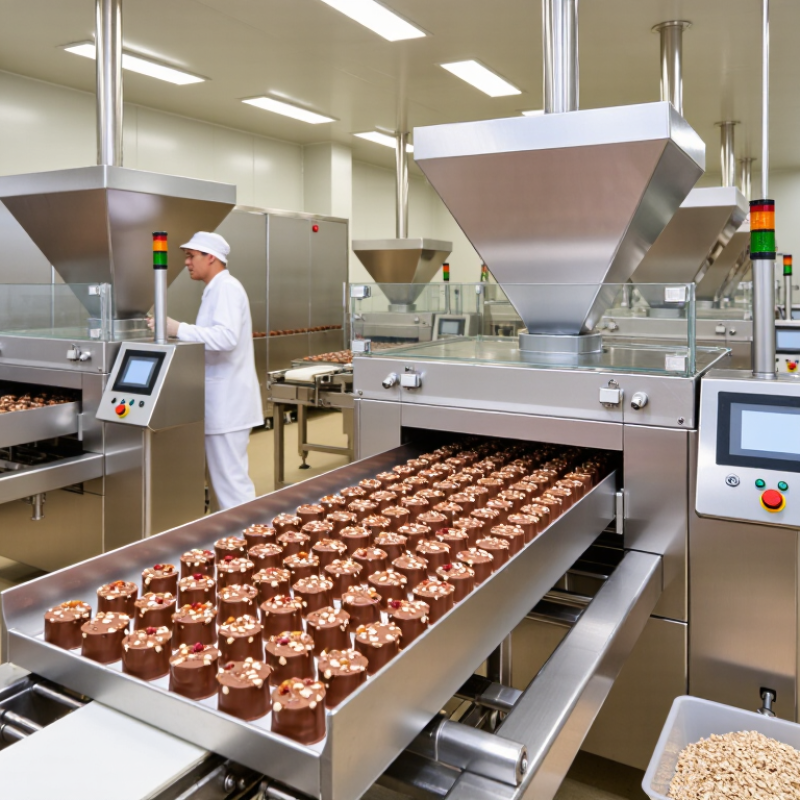
Oatmeal chocolate moulding machines combine tempering, depositing, cooling, and demoulding in one production line. The process begins with stable chocolate tempering, which supports a glossy finish and clean breaking texture. Oat particles can disturb flow, especially when they are large, dry, or unevenly distributed. Consistent particle size matters. Forming matters.

A practical machine should match the product recipe, mould shape, and desired output. Small systems may produce a few hundred kilograms daily, while industrial lines can handle several tonnes per day. However, advertised capacity can be misleading without details about mould size, deposit weight, cooling time, and changeover losses. I would compare hourly output under real operating conditions, not only the highest figure in a brochure. Fast cleaning and simple mould replacement also protect usable production time.

Automation ranges from manual filling to fully synchronized servo-controlled lines. Basic automation can regulate temperature and depositing volume. Advanced systems may connect sensors, recipe storage, conveyor timing, cooling tunnels, and fault alerts. These features improve repeatability, but they also require trained operators and dependable maintenance. More automation is not always better. A reliable line should use food-contact materials, accessible inspection points, guarded moving parts, and clear calibration procedures. In testing, small inconsistencies often appear around oatmeal distribution, so sampling should cover the whole shift, not just the first tray.

Compare 30–100 kg/h Throughput and ±1% Portion-Dosing Accuracy

What Are the Top Oatmeal Chocolate Moulding Machines?

For oatmeal chocolate production, throughput and portion accuracy must be evaluated together. Machines rated from 30 to 100 kg/h suit different production scales. A 30 kg/h system may offer better control for seasonal products and frequent recipe changes. Higher-capacity equipment can reduce labor, but it often requires steadier feeding and longer cleaning routines.

Portion-dosing accuracy of ±1% is a useful benchmark, not an automatic guarantee. Oat particles, chocolate temperature, and mixture viscosity can affect each deposit. A servo-driven depositor with load-cell feedback may maintain consistent weights more effectively. However, operators should verify performance using repeated samples from the beginning, middle, and end of a run. Test it properly. Small errors grow.

In practical trials, record actual output rather than relying only on the specification sheet. A machine listed at 100 kg/h may deliver less when the mixture contains uneven oat flakes or requires slower cooling. Check hopper design, nozzle access, dosing response, and cleaning time. These details influence daily productivity. I would also request a sample test with the intended recipe, because laboratory results can look better than factory conditions. The ±1% target may remain realistic, but only with stable temperature, consistent ingredients, and regular calibration. That limitation matters.

Evaluate Tempering Control at 31–32°C for Dark Chocolate Moulding

For oatmeal chocolate moulding machines, tempering control deserves more attention than headline output. Dark chocolate usually needs a stable working range of 31–32°C after controlled cooling. Small drift matters. At 30.5°C, fat crystals may remain unstable, causing dull surfaces, grey streaks, or weak snap. Above 32°C, the desired crystal structure can begin to disappear.

A practical evaluation should measure temperature at the tempering bowl, transfer pipe, and depositor nozzle. These points may differ by 0.5–1°C during production. The machine should provide continuous sensors, adjustable heating, and gentle agitation.

Oatmeal adds another challenge. Its particles can interrupt flow, settle in the hopper, or create uneven mould filling. A slow agitator and short transfer distance usually help. Watch the edges. Surface cooling can be faster there.

The International Cocoa Organization’s 2023/24 Annual Report estimated cocoa production at about 4.33 million tonnes, against demand near 4.81 million tonnes. The reported deficit highlights why stable processing and reduced waste matter. FAO’s Food Outlook 2024 also identified cocoa price volatility as a supply risk.

Efficient tempering can protect every batch, but not perfectly. Trial runs should record viscosity, gloss, shell release, and break quality. My own assessment would not rely on one temperature reading. A machine may display 31.5°C while the nozzle behaves differently. That gap deserves investigation.

Verify HACCP, ISO 22000, and FDA 21 CFR Food-Contact Compliance

Choosing among the top oatmeal chocolate moulding machines requires more than comparing speed and mould capacity. In production trials, I examine stainless-steel surfaces, sealed bearings, hopper access, and cleaning time. Oat particles and chocolate residue collect in narrow corners. Those details matter.

HACCP verification should identify hazards around allergens, temperature control, sanitation, and foreign materials. Ask for the machine’s hazard analysis, critical control points, cleaning procedures, and corrective-action records. ISO 22000 evidence should include a current certificate, certification scope, audit status, and documented food-safety management procedures. A certificate alone is not enough. The scope must cover relevant manufacturing activities.

For FDA 21 CFR food-contact compliance, request material declarations for moulds, hoppers, seals, hoses, lubricants, and coatings. Check whether each material meets the applicable FDA requirements for its intended use, temperature, and food type. Supporting migration tests and supplier traceability strengthen the review. During one factory audit, I found a compliant-looking gasket without clear batch records. That gap required follow-up. It reminded me that paperwork and machine design must agree. A practical acceptance test should include washdown, allergen changeover, residue inspection, and several hours of stable moulding. Perfect documentation is rare, but unexplained gaps should never be ignored.

What Are the Top Oatmeal Chocolate Moulding Machines? - Verify HACCP, ISO 22000, and FDA 21 CFR Food-Contact Compliance

Comparative guide to machine configurations for oatmeal–chocolate products
Rank Machine configuration Best application Typical output range* Product and process suitability HACCP verification ISO 22000 verification FDA 21 CFR food-contact verification Key acceptance evidence
1 Servo depositor with heated chocolate hopper Oatmeal chocolate clusters, bars, drops, and inclusions Approximately 20–120 deposits/minute, depending on nozzle count and product viscosity Suitable for controlled dosing of chocolate or an oatmeal–chocolate mass; servo control supports repeatable weights and portion sizes Confirm that the installation is covered by the processor’s HACCP plan, including allergen, temperature, cleaning, and foreign-material controls Request the manufacturing site’s current ISO 22000 certificate and verify its scope covers food-processing equipment or applicable manufacturing activities Obtain supplier declarations for product-contact plastics, elastomers, lubricants, and stainless-steel components; FDA status applies to the specific material and intended use Material declarations, hygienic design review, temperature records, calibration certificates, and cleaning validation
2 One-shot chocolate moulding line with filling capability Filled oatmeal pralines, coated bites, and moulded centres Approximately 200–1,200 kg/hour, depending on mould format, recipe, and cooling capacity Provides simultaneous shell, filling, and sealing operations; appropriate where accurate filling and clean product release are required Verify hazard analysis for allergens, thermal treatment where applicable, chocolate tempering, cooling, cleaning, and product changeover Request a valid certificate from an accredited certification body; confirm that the certificate scope and site address match the equipment supplier Check 21 CFR compliance documentation for moulds, pumps, seals, hoses, coatings, and lubricants that contact chocolate or filling Full bill of materials, food-contact declarations, allergen-changeover procedure, cooling profile, and traceability records
3 Chocolate bar and slab moulding line Oatmeal chocolate bars, snack slabs, and portioned blocks Approximately 100–600 kg/hour, depending on bar dimensions and mould pitch Suitable for solid chocolate containing dry oatmeal inclusions; requires controlled vibration and cooling to limit voids and surface defects Include inclusion handling, metal detection, allergen segregation, tempering, cooling, and packaging as controlled steps in the HACCP study Verify certification status, audit scope, certificate validity, and whether outsourced fabrication is included in the certified food-safety management system Require declarations for mould polymers, conveyor belts, release coatings, seals, and processing lubricants used in the food-contact zone Dimensional drawings, contact-material specifications, cooling validation, hygienic weld inspection, and maintenance instructions
4 Rotary depositor or rotary moulding machine Soft oatmeal–chocolate cookies, filled biscuits, and formed snack pieces Approximately 100–600 pieces/minute, depending on drum size, cavity count, and dough characteristics Well suited to cohesive doughs or masses; less suitable for large, hard chocolate inclusions that may damage cavities or disrupt release Verify controls for raw oatmeal, moisture, allergen cross-contact, dough temperature, cleaning access, and post-forming contamination Obtain the supplier’s ISO 22000 certificate or documented equivalent only where the procurement specification permits an alternative standard Confirm that drum surfaces, scrapers, seals, belts, and food-grade lubricants have appropriate food-contact documentation for the process conditions Food-contact surface list, cleanability assessment, allergen validation, wear-particle controls, and spare-part specifications
5 Cold-forming and chocolate-enrobing line Oatmeal bars, granola-style pieces, and chocolate-coated snack products Approximately 200–1,000 kg/hour, depending on slab width, cutting speed, and enrober width Effective for formed oatmeal masses that are cut before coating; requires control of mass cohesion, coating temperature, and cooling time Assess hazards across mixing, forming, cutting, enrobing, cooling, and packaging; include allergen and foreign-material monitoring Verify certificate scope for the supplier’s production site and review internal audit, corrective-action, and supplier-control records Check food-contact compliance for forming belts, cutting wires, coating curtains, pumps, scrapers, seals, and cleaning chemicals Process flow diagram, contact-zone materials register, coating-temperature validation, sanitation procedure, and calibration records
6 Laboratory or pilot-scale moulding system Recipe development, sampling, market testing, and small-batch production Approximately 5–100 kg/hour, depending on hopper size and mould format Best for validating oatmeal particle size, chocolate viscosity, mould release, cooling behaviour, and target piece weight before scale-up Use the pilot unit within the same documented hazard analysis and sanitation program intended for commercial production ISO 22000 certification is normally a site-level requirement rather than a machine-level attribute; verify the applicable supplier site documentation Request declarations for all food-contact parts, including interchangeable moulds, tubing, seals, coatings, and lubricants Pilot trial report, material certificates, cleaning validation, temperature mapping, and repeatability study
*Important verification note: Capacity figures are indicative engineering ranges, not guaranteed performance claims. HACCP and ISO 22000 are food-safety management systems applied to operations or sites; they are not automatically certifications of an individual machine. FDA 21 CFR compliance must be confirmed for each food-contact material, its intended food type, temperature, and time of use. Request current, traceable documentation before purchase and commissioning.

Select the Best Machine by Changeover Time, Energy Use, and Product Range

Selecting an oatmeal chocolate moulding machine requires more than comparing hourly output. Changeover time often decides whether small orders remain profitable. A practical target is a 20–40 minute switch between mould formats. Tool-less clamps, accessible dosing heads, and guided cleaning steps can reduce delays. Operators should time the full process, including chocolate draining, hopper cleaning, mould replacement, and temperature recovery. A machine may advertise a quick format change, yet sanitation can expose the real weakness.

Energy use deserves equal attention. Heated tanks, pumps, conveyors, and cooling tunnels may consume power even during short pauses. Look for insulated hoppers, variable-speed drives, and standby settings that lower heat without damaging chocolate texture. Measure kilowatt-hours per batch under normal conditions. Laboratory figures can be optimistic. Ambient temperature, oatmeal moisture, and repeated starts may change the result. This is easy to underestimate.

Product range separates a flexible machine from a narrow one. Check whether it handles solid bars, oatmeal clusters, filled pieces, and different deposit weights. Servo-controlled depositing can improve portion accuracy when oat particles vary in size. Ask for a trial using your actual recipe, not a smooth sample mixture. A wide range sounds attractive, but extra attachments increase cleaning time and training needs. Sometimes the simpler machine performs better. That possibility deserves honest consideration before purchase.